
Flour, sugar, starch, milk powder, and dozens of other food ingredients are materials that appear on grocery store shelves and in home kitchens. They do not read as industrial hazards. But when these materials are processed in bulk, the fine particles they generate can form explosive dust clouds at concentrations capable of causing serious damage to equipment, facilities, and the people working in them.
Explosion risks in food processing are well-documented, and the consequences of an unprotected event are severe. The 2008 Imperial Sugar explosion in Port Wentworth, Georgia, which resulted in 13 fatalities, is one of the most cited incidents in combustible dust safety. It happened in a facility handling a material found in virtually every household pantry. The hazard was not obscure. What was missing was the recognition of how the conditions inside that facility had created the conditions for it.
This post covers where combustible dust hazards originate in food processing environments, which operations and materials carry the highest risk, and what a practical protection strategy looks like for facilities at every point in the production chain.
Why Explosion Risk Is Such a Serious Issue in Food Processing
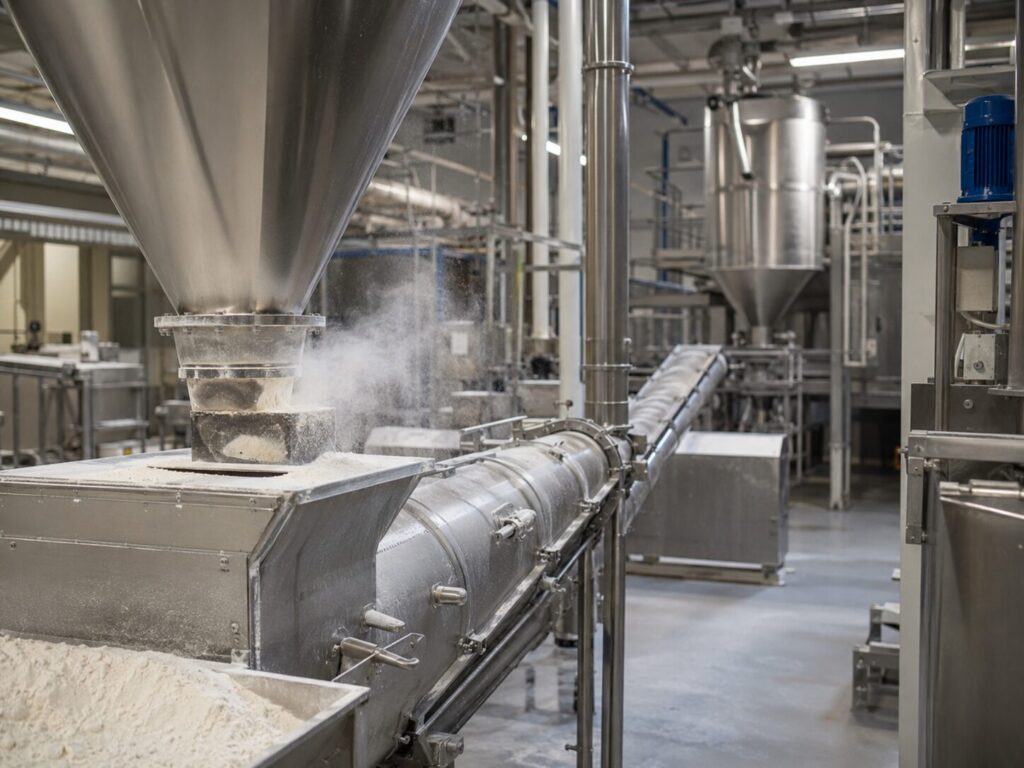
Food processing presents a challenging combination of conditions for combustible dust hazards: large volumes of organic materials processed at high speeds, significant mechanical energy, and processes specifically designed to create fine particles. Grinding, milling, and drying operations are engineered to reduce particle size or remove moisture, and both activities generate the kind of fine, dispersible dust that can form an ignitable cloud when suspended in air.
The hazard is not limited to specialized ingredients. Flour, powdered sugar, starch, cocoa, and a wide range of food additives and flavoring agents all fall within the category of combustible dusts. When these materials are handled in sufficient quantities under the right atmospheric conditions, the risk of deflagration or explosion is real and quantifiable.
What makes food processing particularly complex is the breadth of the industry. A large flour mill and a small regional bakery are not operating at the same scale or under the same conditions, but both handle combustible materials. Understanding where explosion risk is most concentrated and where it tends to be underestimated is the starting point for meaningful protection.
The Most Common Combustible Dust Hazards in Food Processing Facilities
Grinding and Milling Operations
Grinding and milling operations represent one of the highest-risk processes in food ingredient manufacturing. The combination of high-speed mechanical equipment, significant heat generation, and the intentional creation of fine particles means that both the fuel source and potential ignition sources are present by design.
When raw materials such as corn, wheat, or sugar are reduced from granular form to fine powders, the output is a concentrated combustible dust. Mechanical failures, bearing overheating, foreign object contamination, or process upsets can introduce ignition sources into an environment already carrying a suspended dust cloud. The probability of a hazardous event in an unprotected grinder or mill is not theoretical. It is the reason these operations are specifically addressed in combustible dust standards.
Drying and Spray-Drying Processes
Drying operations introduce a different but related risk profile. Spray dryers, drum dryers, and fluid bed dryers remove moisture from wet or slurry-form materials by exposing them to heated air or gas. When this process is not tightly controlled, localized over-drying can cause material to char or form embers, creating an ignition source inside a process that is continuously handling combustible powder.
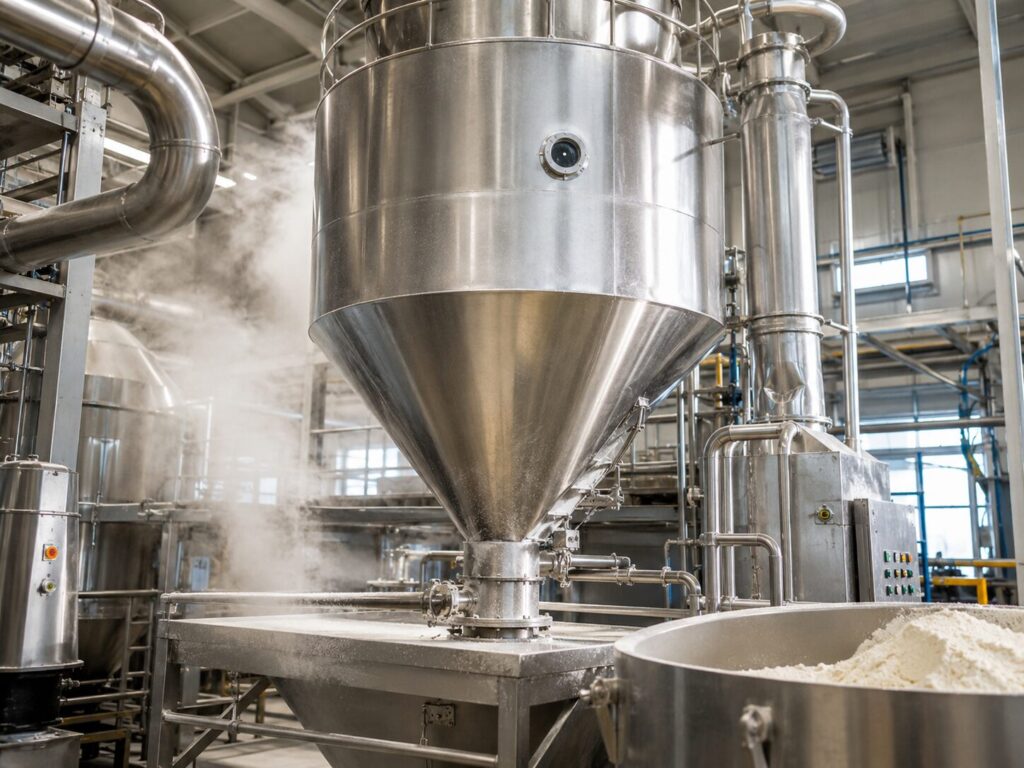
Spray dryers are particularly common in the production of starch, milk powder, and flavoring agents. The output particle size, drying temperature, and air-to-material ratios must all be managed carefully to prevent smoldering or ignition events. These processes are statistically among the most significant locations for combustible dust incidents in ingredient manufacturing.
Dust Collection Systems
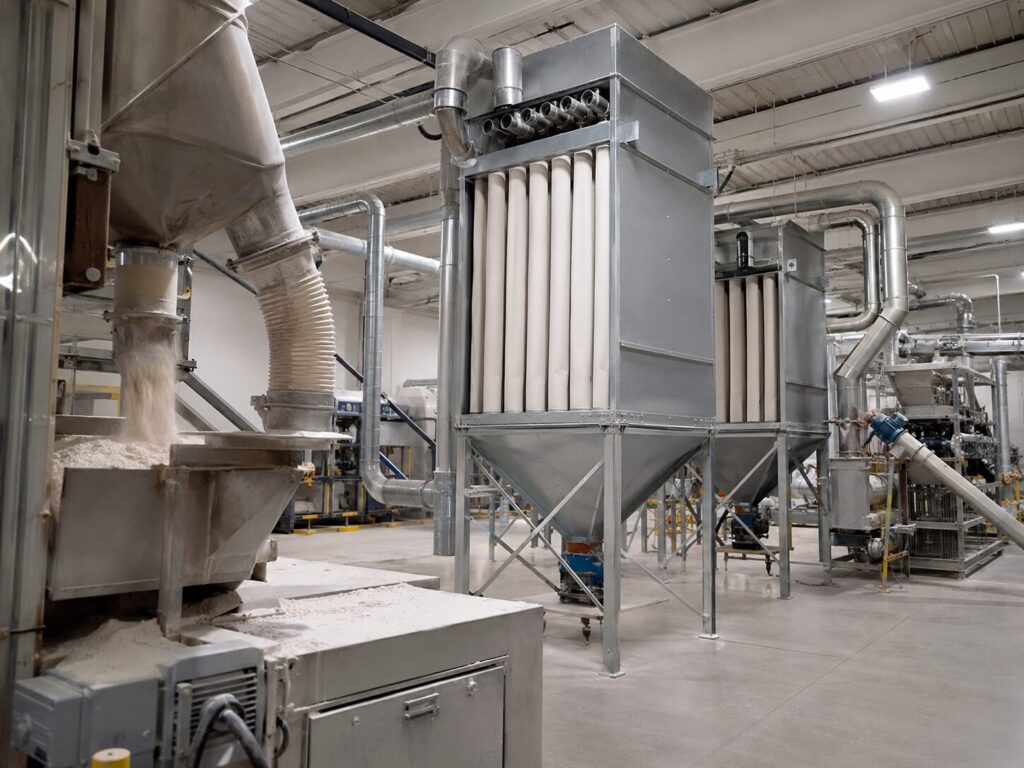
Dust collection systems are among the most statistically significant locations for combustible dust incidents in food processing. Their function is to capture and concentrate fine particulates from processing operations, which means they are, by design, always handling combustible dust at or near the minimum explosive concentration.
A dust collector that lacks proper explosion venting or isolation can propagate a deflagration from the collection chamber back into connected process equipment or vent hot gases and flames into the occupied facility. In food environments, collection systems are often connected to multiple upstream processes, making propagation risk broader than a single piece of equipment.
Elevators, Conveyors, Silos, and Pneumatic Transfer
Bucket elevators, screw conveyors, silos, and pneumatic transfer systems are the infrastructure through which bulk food materials move within a facility. Each presents a distinct explosion hazard profile.
Bucket elevators create repeated mechanical disturbance of material as it is carried upward, generating suspended dust while also containing moving components that can produce friction and heat. Silos accumulate large volumes of settled material and can experience ignition from static discharge or smoldering material carried in from upstream processes. Pneumatic transfer systems operating under positive pressure push dusty air out through any leak point, creating fugitive dust in the surrounding environment. Facilities that underestimate the dust accumulation from leaky conveying systems often face a secondary hazard that is more difficult to control than the primary process itself.
Which Food Products and Process Types Carry the Highest Risk?
Ingredient Processing vs. Finished Food Production
Food processing can be broadly divided into two categories: ingredient manufacturing, where raw agricultural products are processed into powdered or refined materials, and finished food production, where those ingredients are combined and transformed into consumable products.
Ingredient manufacturing carries a higher inherent risk profile. A facility producing flour, starch, or spray-dried milk powder handles its primary product in concentrated powder form throughout the entire process. The material is the hazard, and it is present at scale. These facilities typically involve the high-energy processing equipment, such as grinders, dryers, and mills, that also carries elevated ignition potential.
Finished food production facilities use those same ingredients but often benefit from engineering controls designed to prevent foreign object contamination. Screens, magnets, and enclosed transfer systems maintained for food safety reasons also reduce ignition sources. The hazard is still present, but the combination of quality control requirements and process design tends to produce a somewhat lower overall risk profile compared to upstream ingredient manufacturing.
Why Some White Powders Are Not Equal
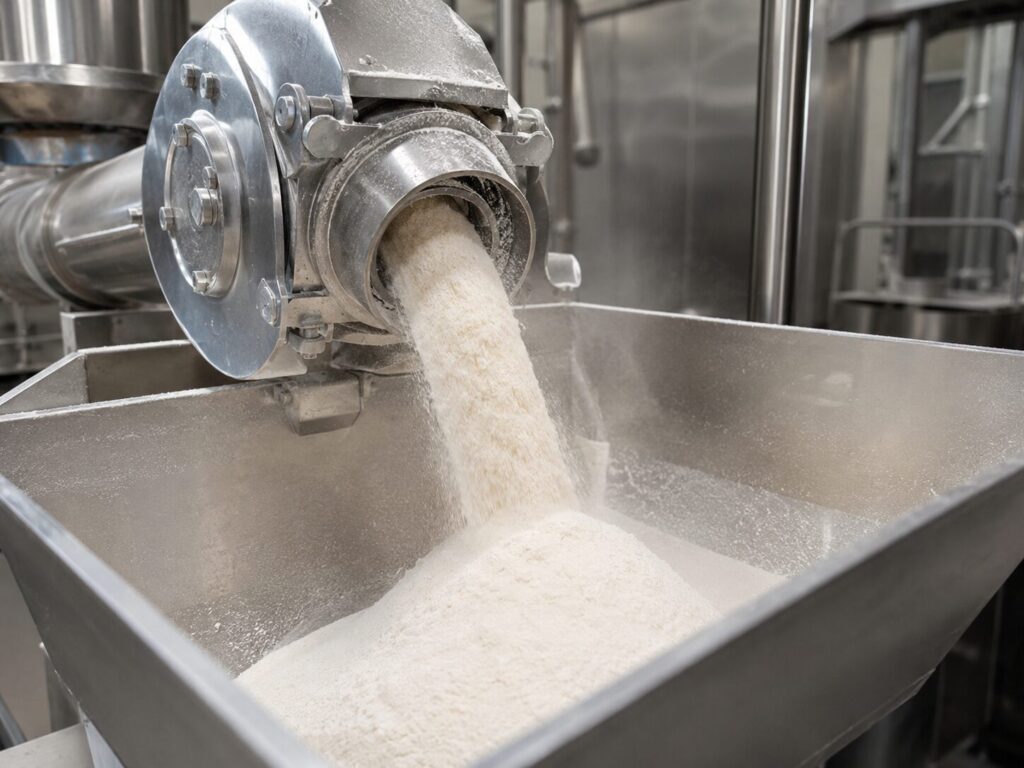
One of the most important distinctions in food processing explosion risk is that not all combustible dusts behave the same way. Flour and cornstarch are both white powders handled in similar environments, but they have meaningfully different explosion parameters. Materials like niacin, a common food additive and vitamin supplement, have significantly lower ignition energy thresholds and require additional precautions beyond what would be applied to flour of a comparable particle size.
Understanding the specific explosibility parameters such as KSt, Pmax, minimum ignition energy, and minimum explosible concentration values for each material handled in a facility is essential for proper safety concept design and explosion protection system sizing. Applying a generic standard based on material category rather than confirmed material-specific data can result in protection concepts that are inadequate, or unnecessarily restrictive, or both.
The Biggest Blind Spots Food Processing Facilities Miss
Trusting Incoming Materials Too Much
On the receiving end of a food processing operation, there is often a degree of trust extended to incoming materials. The assumption is that deliveries arriving in sealed bulk containers or tanker trucks are clean, free of contamination, and properly prepared. When that assumption holds, the receiving and transfer process carries limited additional risk.
However, the transfer process itself introduces hazards that are independent of material quality. Static grounding and bonding between trucks, transfer piping, and receiving silos is a specific and commonly overlooked requirement during bulk transfer operations. If a silo is protected with explosion venting but there is no isolation on the fill line, a deflagration event within the silo can propagate back through the piping to the transport vehicle. This scenario is addressed in NFPA standards but is frequently missed in practice.
Underestimating Fugitive Dust and Housekeeping
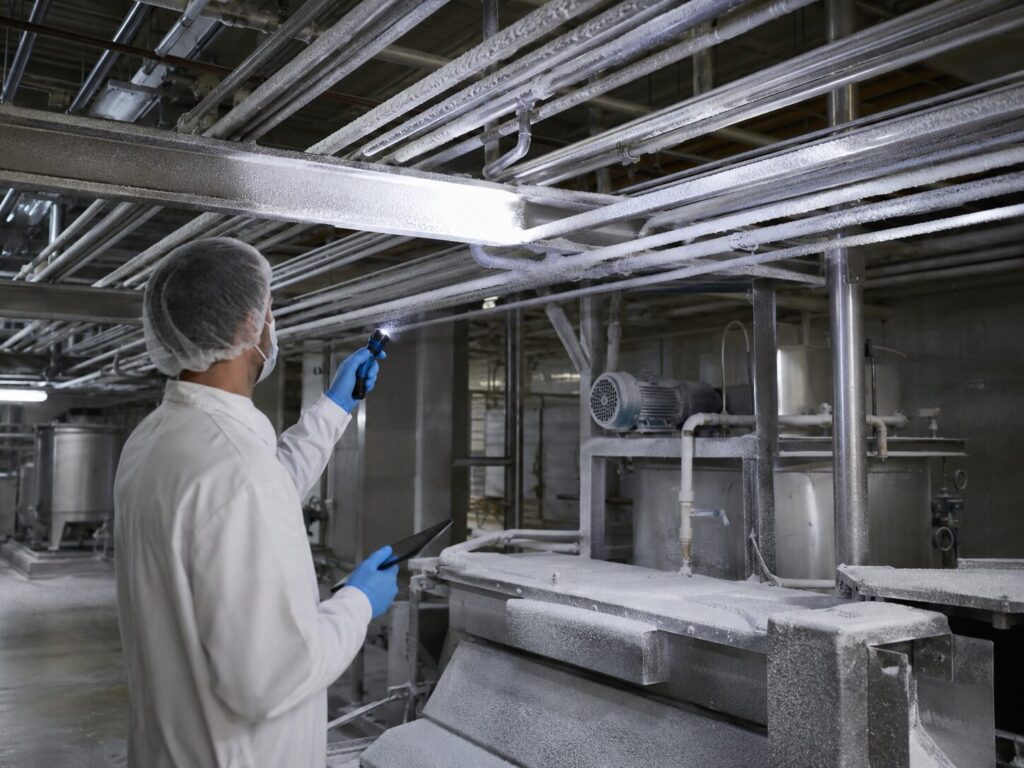
The most significant explosion hazard in many food processing facilities is not inside the process equipment. It is in the facility itself. Dust that escapes from leaky piping, unsealed transfer connections, or inadequately maintained equipment settles on floors, equipment surfaces, and structural members. When a disturbance lifts that settled dust back into suspension, the resulting flash fire or explosion occurs in an occupied space, not inside a contained vessel.
Housekeeping is not a secondary concern. Maintaining clean surfaces, addressing leaks in conveying systems promptly, and ensuring that positive-pressure pneumatic lines are properly sealed are among the most effective risk-reduction measures available to any food processing facility. In some operations, accumulated dust layers create hazard conditions that cannot be addressed through equipment modifications alone.
Assuming Closed Transfer Means No Real Hazard
NFPA standards acknowledge that certain closed-loop material transfer operations, where material moves from one vessel to another in a sealed system without the introduction of ignition sources, present a lower risk profile that may not require formal explosion protection. This is a reasonable engineering position in the right circumstances.
The risk is in applying that reasoning too broadly. If the material involved has a very low ignition energy threshold, powdered sugar and certain starches are examples commonly cited in the food industry, or if manual dumping or open transfer occurs at any point in the process, the exemption logic does not apply. A careful evaluation of the actual process conditions is required before concluding that protection is unnecessary.
Ignoring Upset Conditions
When evaluating combustible dust hazards in processing facilities, it is essential to consider upset conditions in addition to normal operating scenarios. Process deviations such as equipment malfunctions, blockages, loss of ventilation, abnormal material accumulation, power loss, process upsets, or operator errors can significantly increase the likelihood and severity of a dust explosion event. These non-routine conditions often create elevated dust concentrations, introduce unexpected ignition sources, or compromise the effectiveness of existing protection systems. While a facility may appear safe during normal operation, many combustible dust incidents occur during startup, shutdown, maintenance, or other abnormal operating states. A comprehensive hazard assessment should therefore identify credible upset scenarios and evaluate their potential impact to ensure that dust explosion prevention and mitigation measures remain effective under both normal and abnormal conditions. Overlooking Indoor Equipment Risk
Equipment installed indoors without explosion venting, or with venting that discharges into the facility rather than to a safe outdoor location, presents a significant risk to personnel and building structure. This situation is particularly relevant for bucket elevators, which are sometimes installed without explosion protection because the equipment supplier does not include it by default and the end user may not be aware that the omission requires correction.
A deflagration event inside an indoor bucket elevator that lacks proper protection or that vents into the occupied facility rather than safely outdoors can extend far beyond the elevator itself. Flameless venting technology provides an option for indoor equipment that cannot be vented to the atmosphere, allowing the deflagration energy to be contained without external discharge.
How NFPA 660 Changes the Conversation for Food Processors
NFPA 660, the Standard for the Prevention and Control of Combustible Dust Fires and Explosions, consolidated several previously separate standards, including NFPA 61, which specifically addressed food and agricultural operations. The food and agriculture provisions are now located in Chapter 21 of NFPA 660.
For food processing facilities, one of the most significant aspects of the current standard involves Dust Hazard Analysis (DHA) requirements. NFPA 660 Chapter 21 applies DHA requirements to new facilities and to existing facilities undergoing significant modifications, defined as those exceeding 25 percent of the replacement cost of the affected system. Within this framework, specific emphasis is placed on equipment categories consistently associated with combustible dust incidents in the food and agricultural sector: bucket elevators, conveyors, grinding equipment, spray dryers, and dust collection systems.
The food and agriculture provisions reflect a balance between the engineering realities of large commercial processors and the practical constraints of smaller agricultural operations. This means that some facilities may not be formally required to complete a full DHA under the standard’s specific thresholds. However, the absence of a regulatory requirement is not a risk management strategy. Facilities that evaluate their actual hazard conditions against NFPA 660’s framework, even informally, are better positioned to understand where protection gaps exist and to address them before an incident forces the conversation.
What a Practical Risk-Reduction Strategy Looks Like
Start with Hazard Recognition
The starting point for any explosion risk reduction effort is a clear, honest assessment of which materials, processes, and equipment represent real combustible dust hazards. This means identifying the materials handled in the facility, confirming their combustibility and explosion parameters, and mapping the processes where those materials are present in conditions that could support an explosive atmosphere.
A formal Dust Hazard Analysis provides the structured framework for this assessment. Even for facilities not formally required to complete a DHA under NFPA 660’s food and agriculture provisions, conducting one provides documentation of known hazards, existing safeguards, and any gaps that need to be addressed. The value is in understanding the actual risk, not in satisfying a compliance threshold.
Review Equipment and Process Design
Once hazards are identified, the existing protection measures on each piece of equipment should be evaluated against the confirmed material parameters and specific process conditions. Protection systems that were sized for one material may not be adequate if the facility has changed its ingredient mix. Equipment installed without protection, or with protection that was not engineered to confirmed specifications, should be reviewed against current standards.
This review should include equipment that appears low-risk on the surface. A receiving hopper handling a material with low minimum ignition energy may require protection even if the primary process equipment downstream is already addressed. The specific process context determines the answer, not the category of equipment alone.
Improve Housekeeping and Leak Control
Housekeeping improvements and leak control measures address the fugitive dust hazard that exists independently of the process equipment. Identifying and sealing leaks in positive-pressure conveying systems, establishing and maintaining cleaning schedules for settled dust on structural surfaces, and ensuring that displaced air from filling operations is properly vented all reduce the risk that a localized event inside equipment will escalate into a facility-level incident.
These measures do not require capital investment in protection equipment. They are operational practices that are consistently cited in post-incident investigations as the difference between a contained equipment event and a catastrophic facility explosion.
Use DHA Findings to Guide Protection Choices
Protection system selection should follow from the hazard assessment findings. The specific KSt and Pmax values for the materials handled, the geometry and volume of the protected equipment, the indoor or outdoor installation location, and the connection topology of the process all factor into the appropriate protection concept for each piece of equipment.
Explosion venting is well-suited for equipment that can discharge safely to the outdoors. Flameless venting provides an indoor-compatible alternative where outdoor venting is not feasible. Isolation systems, passive or active, prevent deflagration propagation between connected vessels. The right protection concept is determined by the specific hazard profile, not by a uniform approach applied across all equipment.
Can Existing Food Processing Equipment Be Retrofitted for Better Explosion Protection?
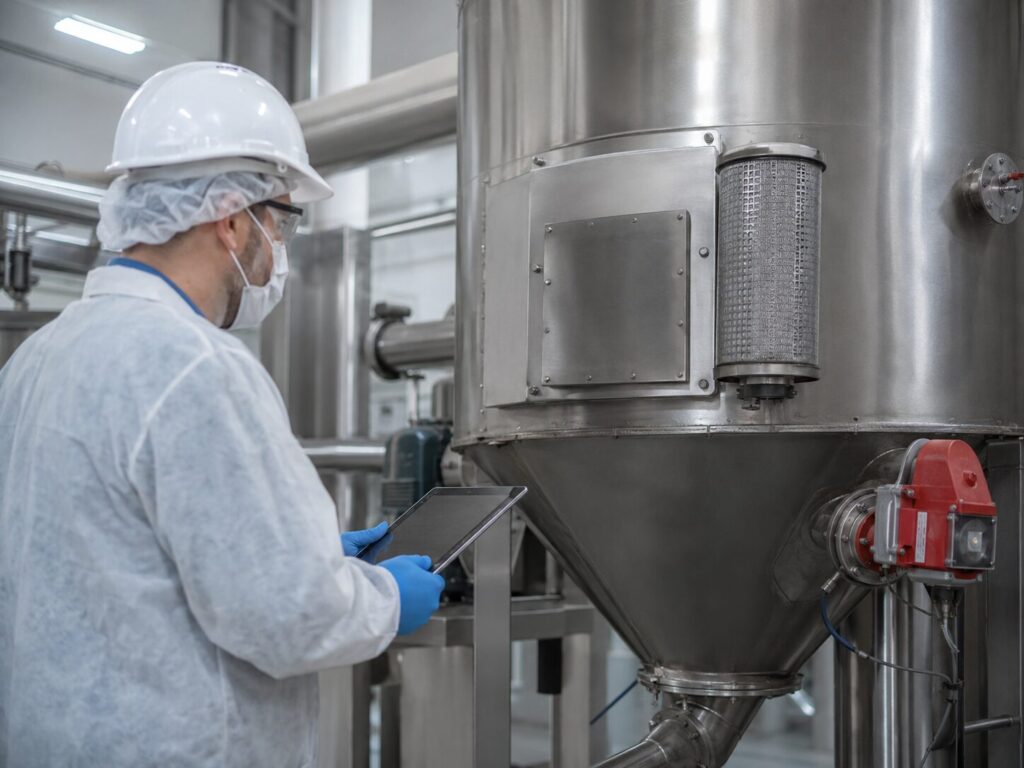
In many cases, yes. When REMBE® conducts facility site evaluations, a common finding is process equipment that was installed without explosion protection or with protection concepts that may not have been properly sized for the materials currently being handled. Retrofitting protection is often technically feasible even when the equipment was not originally designed with it in mind.
For indoor vessels and hoppers, flameless venting is frequently the most practical retrofit option. A flameless vent captures the hot gases and burning particles from a deflagration event and dissipates the energy within the unit, allowing the vent to operate safely in an occupied indoor space. Isolation can be added to fill lines and connecting pipes to prevent propagation into connected equipment or back toward upstream processes.
For equipment with existing explosion venting that may not have been properly engineered, calculations can be performed to verify whether the current vent area is adequate for the confirmed material parameters, and additional or replacement venting can be installed where needed. The feasibility of each retrofit depends on the equipment geometry, the installation environment, and the specific hazard profile, but the option should not be dismissed without an engineering evaluation.
Is It Possible to Overengineer Explosion Protection?
It is possible. Applying explosion protection measures to equipment or materials that do not present a real combustible dust hazard adds cost and operational complexity without a corresponding safety benefit. In food processing environments, this can take the form of explosion venting or suppression systems installed on vessels handling non-combustible materials such as salt or baking soda, neither of which requires protection against a hazard that does not exist.
Suppression systems, in particular, carry a meaningful operational burden in food environments. They require quarterly maintenance and are susceptible to false activations from process vibrations, pressure transients, or mechanical impacts. A false activation in a process handling milk powder, starch, or similar ingredients results in contamination of the entire affected process line with the suppression agent, requiring a full shutdown, cleaning, and recommissioning before production can resume.
The right engineering approach distinguishes between hazards that require protection and processes where the risk has been genuinely evaluated and found to be below the threshold requiring intervention. REMBE®’s approach to food processing applications is to help facilities understand their actual hazard conditions so that protection decisions are grounded in confirmed risk, calibrated to the process, and applied where they are warranted.
How Often Should Food Processors Review Explosion Hazards?
NFPA 660 recommends that Dust Hazard Analyses be reviewed on a five-year cycle. This regular review ensures that the DHA reflects current process conditions, updated material data, and any equipment modifications made since the last assessment.
A formal five-year review, however, is not a substitute for managing hazard changes as they occur. Any modification to process equipment, changes to ingredients or material specifications, changes to operating procedures, or changes to facility layout should trigger a management of change review to evaluate whether existing protection measures remain appropriate. If a new material is introduced with different explosion parameters, or if a process change connects previously isolated equipment, the protection concept should be re-evaluated before the modification goes into service.
In facilities where explosion protection equipment is installed but not well understood by current plant personnel, a hazard assessment also serves as an opportunity to confirm that existing equipment is functional and properly maintained and that the personnel responsible for it understand what it is designed to do. Protection systems that are bypassed, blocked, or unknown to the people working around them provide no protection at all.
Questions Food Processors Should Ask About Explosion Risk Now
Before leaving hazard assessment in the abstract, there are specific questions that plant and safety engineers at food processing facilities should be able to answer about their own operations.
Have we confirmed the combustibility and explosion parameters for every material we handle? Generic material categories are not sufficient for protection system sizing. Confirmed KSt, Pmax, minimum ignition energy, & minimum explosive concentration data for each specific material is the foundation of a properly engineered protection concept.
Do we know which pieces of equipment in our facility lack explosion protection, and have we evaluated whether protection is warranted? The absence of protection is not the same as confirmation that protection is unnecessary.
Have we assessed our fugitive dust and housekeeping conditions independently of our process equipment? Settled dust on building surfaces is a separate hazard from the dust inside process equipment, and it requires a separate evaluation.
Are our dust collection systems connected to process equipment in a way that allows deflagration propagation? Isolation systems between connected vessels are frequently the most critical protection gap identified during facility evaluations.
Does our explosion protection equipment get maintained, and does current plant staff understand what it does? Equipment that has been bypassed, blocked, or simply forgotten by the personnel working around it is not providing the protection it was designed to deliver.
Why a Process-Specific Approach Matters
No two food processing facilities are identical. The combination of materials handled, processes used, facility layout, equipment age, and operational practices creates a risk profile that is specific to each site. Applying protection concepts developed for a different facility, a different material, or a different process without engineering verification of their applicability is not a reliable path to safety or compliance.
The most consistent finding from post-incident investigations in the food processing industry is not that the hazards were unknown. It is that the specific conditions creating the event had not been evaluated. Flour mills, sugar refineries, starch producers, and dust collection systems in finished-goods bakeries all handle combustible materials. What varies is the concentration, the ignition probability, the equipment protection, and the housekeeping discipline. Each of those variables is within the control of the facility.
Working with an engineering partner who understands both the applicable standards and the operational realities of food processing allows facilities to make protection decisions that are calibrated to their actual risk, not applied uniformly and not deferred until an incident forces the conversation.
If your facility handles combustible food ingredients and you have questions about where your explosion protection stands, contact REMBE® to request an engineering consultation or facility evaluation.